Essential Waste Management and Bin Setup Tips
Every overflowing bin tells a larger story about how homes, offices, and cities use resources, discard materials, and pay for the aftermath. Waste management matters because it shapes public health, local budgets, greenhouse gas emissions, and the basic comfort of everyday spaces. A well-designed system turns curbside confusion into routines that recover value and reduce landfill pressure. This article follows that journey from household sorting to broader infrastructure so readers can build cleaner, simpler, and more effective habits.
Outline: the article begins with the purpose and structure of modern waste management, then moves into practical bin setup decisions, explains the differences between recycling, composting, and disposal, explores the role of communities and businesses, and closes with a realistic action plan for households, renters, property managers, and small teams.
Understanding Waste Management Beyond the Bin
Waste management is often reduced to a single moment: the lid closes, the truck arrives, and the material disappears. In reality, that small act sits inside a long chain of decisions involving product design, purchasing, storage, sorting, collection, transport, treatment, recovery, and final disposal. A banana peel does not vanish when it leaves the kitchen; it simply changes address. The same is true for cardboard, plastic film, worn-out batteries, broken furniture, and demolition debris. Managing those flows well is not only a sanitation issue. It is also an economic and environmental discipline.
The World Bank has estimated that the world generates more than 2 billion tonnes of municipal solid waste each year, and the total is expected to rise as populations grow and incomes change. That number matters because poorly handled waste can contaminate water, attract pests, increase fire risk, and add pressure to landfills. Landfills themselves remain necessary in many regions, yet they also create long-term management demands, especially when organic materials break down and release methane, a powerful greenhouse gas. On the other side of the ledger, valuable materials can be recovered when systems are designed with care.
Most local waste streams include several major categories:
- Organic material such as food scraps and yard trimmings
- Dry recyclables including paper, cardboard, metals, and some plastics
- Residual waste that cannot be recovered economically through current programs
- Hazardous items such as batteries, chemicals, paint, and certain electronics
- Bulky or construction material that requires separate handling
One key comparison separates reactive systems from planned systems. In a reactive system, people guess where items belong, contamination rises, collection crews face delays, and more material ends up as trash. In a planned system, bins match the real waste stream, labels are clear, and users understand the consequences of each choice. Municipalities that conduct waste audits often discover a similar pattern: a surprising share of what goes to landfill could have been composted or recycled if the setup had been simpler and better explained.
That is why waste management is not merely about disposal. It is about directing materials toward the best available destination. When readers understand that principle, bin setup becomes less of a household chore and more of a practical operating system for daily life.
Bin Setup Tips That Make Daily Sorting Easier
A good bin setup does not begin with buying containers. It begins with observing behavior. Where does packaging pile up first? Where are food scraps generated? Which rooms produce paper, bottles, or hygiene waste? The most effective systems follow people’s routines instead of forcing people to remember a complicated set of rules. A recycling station hidden in the garage may look tidy on paper, but a small paper bin near a desk or a split station in the kitchen often captures material far more reliably.
For most homes, a basic setup works best when it mirrors the main waste streams: one container for recycling, one for general waste, and one for organics if local composting or green waste collection exists. In apartments without organics service, a compact caddy for food scraps can still help if residents use community composting, worm bins, or drop-off programs. In shared buildings, the labels matter almost as much as the bins themselves. People respond faster to simple examples than to technical rules. A sign that says “Clean paper, cans, and bottles only” is easier to follow than a long paragraph full of exceptions.
Useful setup principles include:
- Place bins where the material is created, not where storage space happens to be available
- Use lids selectively; they help with smells for food waste but may slow recycling use
- Choose liners that match the destination and do not contaminate the stream
- Keep labels large, visual, and consistent with local collection guidance
- Leave enough room for bulky packaging like cardboard to avoid overflow
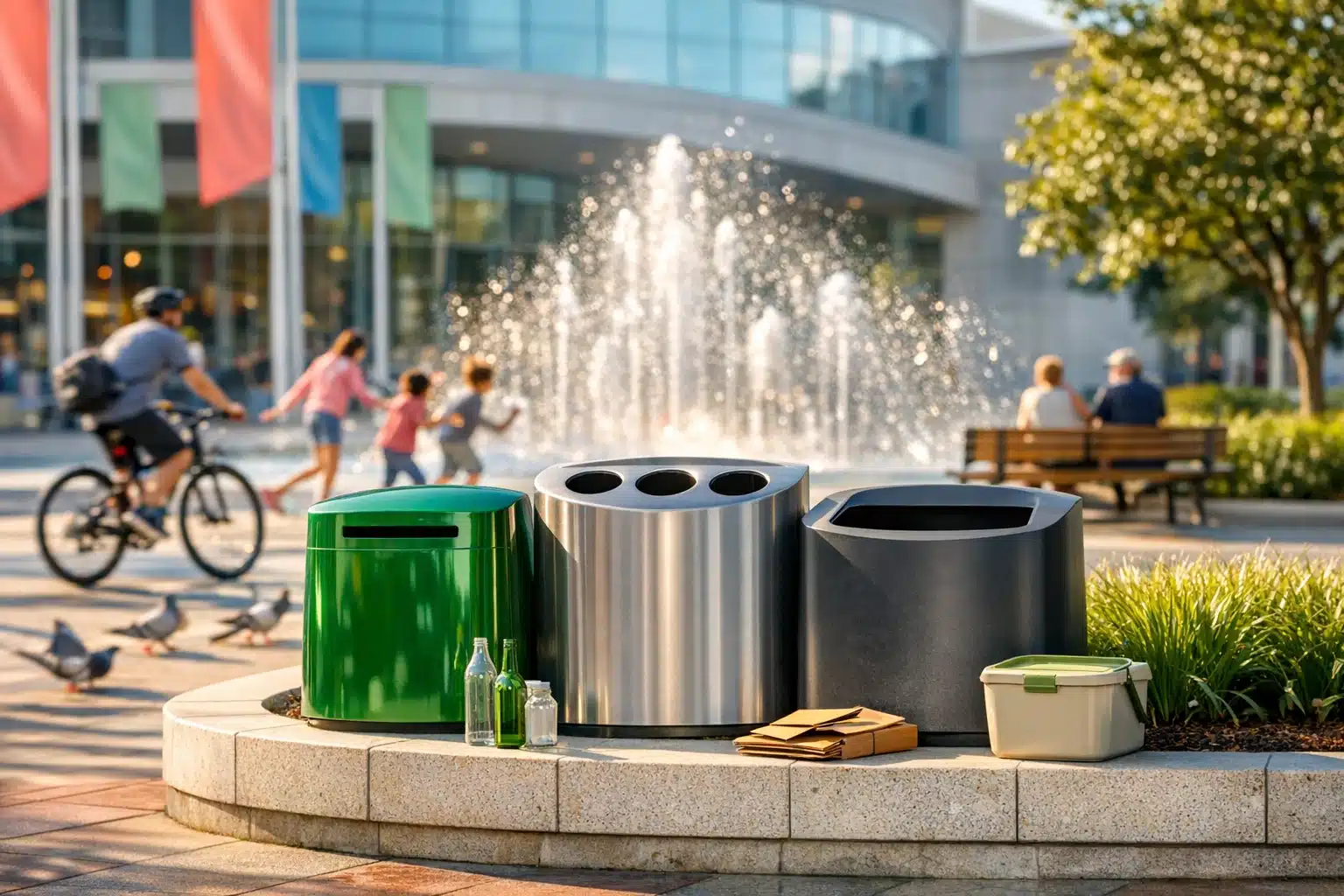
There is also an important comparison between identical bins and differentiated bins. Identical containers can look neat, yet they increase mistakes unless signage is excellent. Differentiated bins use size, color, and shape to guide behavior. For example, a narrow paper slot reduces contamination, while a wider residual bin accepts mixed rubbish more realistically. Still, color systems are not universal. One city may use blue for mixed recycling, another may reserve blue for paper, and a third may avoid color coding entirely. Local rules should always override assumptions.
Small frictions make large differences over time. If rinsing containers is annoying, people stop doing it. If the compost caddy is hard to clean, it gets abandoned. If the outside bins are too far away or impossible to open with full hands, good intentions collapse in the moment. The best setup feels almost invisible because it makes the correct action the easiest one. That is the real goal: not a perfect-looking corner, but a system that people will still use on an ordinary, rushed, slightly messy Tuesday.
Recycling, Composting, and Landfill: Knowing What Goes Where
One of the biggest sources of waste confusion is the assumption that every discarded item belongs somewhere “good” if the user is optimistic enough. That is not how material recovery works. Recycling, composting, and landfill each serve different purposes, and mixing them weakens all three. The better approach is to think of them as separate lanes on a road rather than competing labels on the same box.
Recycling is designed for materials that can be collected, sorted, and processed into feedstock for new products. Common examples include cardboard, metal cans, glass bottles, and certain plastic containers. Yet recyclability depends on local infrastructure, not just on the object itself. A plastic tub accepted in one area may be rejected in another. Contamination is a persistent challenge, and some curbside programs report double-digit contamination rates. Food residue, plastic bags tangled in machinery, and wish-cycling all raise processing costs. Putting the wrong item in the right-colored bin is still a mistake.
Composting serves organic matter such as fruit peels, coffee grounds, tea bags, yard trimmings, and in some systems food-soiled paper. When organics are sent to landfill, they decompose without much oxygen and generate methane. When managed through composting or anaerobic digestion, the same material can be converted into soil amendments or biogas, depending on the system. That is one reason many cities now expand organics collection as part of broader climate strategies.
Landfill, despite its poor reputation, remains the final destination for residual material that cannot be safely or economically recovered through current local programs. The key is to reserve landfill for what truly belongs there rather than treating it as the default.
A practical comparison looks like this:
- Recycle: clean paper, cardboard, metal cans, and locally accepted containers
- Compost: food scraps, yard waste, and approved compostable fibers where permitted
- Landfill: contaminated composites, non-recyclable wrappers, and unusable residues
- Special collection: batteries, electronics, paint, lamps, and chemicals
Several items deserve extra caution. Shredded paper may be recyclable only in some programs. Pizza boxes are often accepted if the clean parts are separated, while greasy sections may belong in organics or trash depending on local rules. Compostable plastics cause confusion because industrial composting facilities differ widely; some accept certified items, others reject them completely. Electronic waste should never be treated as ordinary household trash because it may contain metals and components that require controlled recovery.
The best rule is simple: match the item to the local system, not to the label printed on the packaging. That habit reduces contamination, protects workers, and improves the chances that materials will actually be recovered.
How Communities, Businesses, and Policy Shape Waste Results
Individual effort matters, but no household can recycle its way out of a weak system. Waste outcomes are strongly shaped by municipal collection design, building management, commercial practices, and public policy. A resident may sort perfectly at home, yet if the building provides poor signage or the town lacks organics infrastructure, the final result will still fall short. In that sense, waste management is both personal and structural.
At the community level, collection frequency, truck routing, transfer stations, and sorting facilities determine what is practical. Material recovery facilities separate mixed recyclables through screens, magnets, optical sorters, and manual quality control. If contamination is high, recovery becomes slower and more expensive. If routes are inefficient, municipal costs rise. Some cities use data and fill-level monitoring to improve pickups, while others focus on education campaigns before changing service patterns. Neither technology nor messaging works alone; both need consistent execution.
Policy also matters because it changes incentives. Common tools include:
- Pay-as-you-throw programs that charge more for larger trash volumes
- Deposit return schemes that reward bottle and can recovery
- Mandatory organics separation for large generators in some regions
- Extended producer responsibility systems that shift some costs to manufacturers
- Construction and demolition recovery targets for large projects
Businesses play a major role because offices, restaurants, retailers, schools, and warehouses generate substantial waste. A restaurant may need strong organics separation and grease management, while an office may focus on paper reduction and electronics reuse. Waste audits often reveal expensive habits hidden in plain sight: oversized trash service, recyclable cardboard filling general waste dumpsters, or disposable purchasing patterns that create avoidable cost every week. In such cases, better procurement can be as important as better disposal. Buying reusable serviceware, selecting packaging with clearer recovery options, and consolidating supplies can reduce waste before bins are even involved.
There is a revealing comparison between a building with generic labels and one with a managed system. In the first, residents guess, contamination spreads, and collectors reject loads. In the second, bin rooms are well lit, signage shows real examples, bulky items have designated procedures, and staff monitor problems early. The second building does not succeed because its users are morally superior; it succeeds because the system is legible.
That insight applies widely. Waste performance improves when rules are visible, incentives are aligned, and infrastructure matches the materials people actually discard. Good policy turns individual effort into a dependable public outcome.
Conclusion for Households, Renters, and Small Property Teams
If there is one useful takeaway for everyday readers, it is this: waste management becomes manageable when it is broken into clear, local, repeatable steps. You do not need a complicated zero-waste identity to make meaningful progress. You need the right bins, the right labels, and a realistic understanding of what your local system can process. That combination is more powerful than enthusiasm alone.
For households, the first move is to observe one ordinary week of discards and identify the dominant streams. Many people discover that food scraps and packaging account for most of the clutter. For renters, the next step may be asking building management about collection rules, access to recycling areas, or whether clearer signage can be added. For property managers and small workplace teams, the priority is usually consistency: matching labels across floors, placing stations where waste is actually generated, and checking contamination before it becomes normal behavior.
A simple action plan looks like this:
- Audit what you throw away for seven days without changing your routine
- Set up containers based on real waste volume, not guesswork
- Use local collection rules as the final guide for sorting decisions
- Separate organics where services exist or where drop-off options are available
- Create one clear process for batteries, electronics, paint, and bulky items
- Review the system after a month and fix whichever step people keep avoiding
This topic matters because waste is one of the few environmental issues everyone touches every single day. It shows up after dinner, during renovations, in office break rooms, and at the loading dock behind a shop. That daily contact is not a burden only; it is also an opportunity. Small corrections made often can reduce contamination, lower hauling costs, improve cleanliness, and support better recovery across the whole chain.
The most effective bin setup is not the one with the fanciest containers or the most ambitious slogans. It is the one people understand at a glance and use without hesitation. When systems are designed around ordinary behavior, waste stops feeling like a constant nuisance and starts functioning like any other practical service: quiet, efficient, and reliably under control.